 As the healthcare education landscape becomes increasingly global, many providers are scrambling to cross the Atlantic. But for touchIME, the US market isn’t a new frontier—it’s a reinforced foundation.
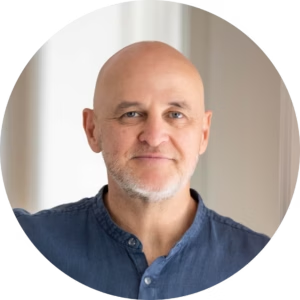
Ahead of the Alliance for Continuing Education in the Health Professions (ACEHP) Annual Conference in Atlanta, GA, USA, we sat down with Sven Awege (Senior Education Development Director) to discuss how a heritage in US publishing, award-winning outcomes and a reinforced medical leadership team are shaping strategy for 2026.
Q. There is often a perception in the industry that touchIME are a ‘European’ company expanding into the US, but we know that’s not the whole picture. How are you framing the US heritage of the platform for the attendees at ACEHP this year?
Exactly. It’s a common misconception that we are just now ‘expanding’ into the US. The reality is that we are reinforcing a massive foundation that has been in place for two decades.
We have a long heritage as a publisher of US peer-reviewed journals, which means we’ve organically built an extensive proprietary database of US learners and have built long-standing, active partnerships with over 40 US medical societies. Bringing in Annette Wiggins in 2024 to head up our US medical team (who brings over 30 years of US CME experience) wasn’t about starting something new. It was the next logical step to overlay senior-level CME experience and governance on top of our existing US infrastructure.
Q. One of touchIMEs core strengths is the strategic work carried out before sending an unsolicited proposal. When you look at a new opportunity, how do you determine if it should be a global initiative or a strictly US-focused program?
Because we mainly operate through unsolicited proposals, the burden is on us to get the strategy right before we submit. We look closely at the therapeutic landscape.
Sometimes the science is universal, like with disease awareness education, and a global program is logical. But often, the US market is in a different phase of the clinical adoption curve or faces unique reimbursement or practice barriers. We don’t believe in a ‘one-size-fits-all’ approach. We use our local insights to design programs that speak directly to US practice gaps, ensuring that the geography of the program serves the science, not the other way around.
Q. We know that US funding portals are highly structured, compared to more of a relationship-based model we often see in Europe. How is your US medical team ensuring that the ‘medical story’ doesn’t get lost in those submission fields?
They are two very different ecosystems, and we respect the integrity of both. In the US, the portal system provides a highly structured, efficient framework that ensures compliance. The challenge, however, is that the ‘human element’, the nuance of the clinical strategy, can sometimes be hard to convey through text fields.
That is where experience counts. Because our US medical leadership understands exactly what US HCPs [healthcare professionals] are looking for conceptually, we can bridge that gap. We write proposals that translate complex clinical needs into the structured language the grants teams require. We ensure the content inside the portal is perfectly aligned with the clinical strategy the organization aims to support, ensuring the program will address the unmet needs we have identified in a meaningful and impactful way.
Q. Reaching and engaging the right learner is always the biggest challenge for supporters. How are you leveraging specific assets, like specialist communities, to differentiate yourselves from other US providers?
We don’t rely on generic outreach. We have developed dedicated specialist platforms covering key areas, which gives us a natural ‘home’ for almost any disease.
A couple of major differentiators here are our ability to offer ‘dual hosting’ and ‘scientific society partnerships’. For example, a program on lung cancer doesn’t just sit in a silo; we can host it simultaneously in our oncology community and our respiratory community. Layered on top of this, we leverage our partnerships with the relevant scientific societies to ensure our programs are disseminated to all the relevant learners. This ensures we engage the full multidisciplinary team, as appropriate, giving the content the broadest relevant exposure possible to the right audiences.
Q. You’re heading to the ACEHP with a strong team, including some ’40 Under 40′ alumni. What is the main message you want to drive home to the supporters you meet there?
I am genuinely excited to attend. I’ve heard fantastic feedback from previous attendees on our team, including colleagues who have been recognized as ’40 Under 40′ honorees by the Alliance. This year, we have another ‘40 Under 40’ awardee being recognized, which just shows the strength of the company for future generations!
Our company actually holds an ACEHP ‘Best in Class Outcomes’ award, and we’ve previously presented at the annual meeting, so we feel very much a part of this community. Since that award we’ve developed and launched an advanced framework for monitoring and assessing outcomes, called the Learner-to-Patient Impact, or LPI, which I believe goes beyond anything available elsewhere right now in terms of providing actionable insight and understanding the true impact on patient outcomes.
Q. Innovation is a recurring focus at ACEHP. In your view, where is innovation having the most meaningful impact right now—content design, delivery formats, learner engagement, or outcomes measurement?
Innovation is a term that gets thrown around a lot, but for us and for our supporters, it can’t just mean ‘new’—it has to mean meaningfully better. When supporters ask where innovation is having the most impact, they are essentially asking: how is this new approach going to solve my core challenge of driving real change in clinical practice?
We believe innovation is not found in one single area, but rather in the strategic integration of all the elements of instructional design. Our focus is on the measurable impact of this integration, ensuring that every piece of content, every delivery format and every engagement mechanism is built to inform our advanced outcomes assessment framework.
We operationalize innovation by focusing on:
- Content design: by leveraging a 20-year peer-reviewed journal history and partnerships with 40 US medical societies – over 200 in total globally – we use local market insight to design content that addresses specific clinical adoption gaps.
- Delivery and engagement: we engage the full interdisciplinary team using vertical specialist platforms for specific disease areas, supported by innovative video educational formats and an optimal UX [user experience].
- Outcomes measurement: The LPI framework, delivers actionable insights into patient impact beyond simple knowledge checks, which is validated using advanced statistical analysis and behavior change theories.
I’m looking forward to reconnecting with our supporters, hearing about the advances that have been made by other peers, and discussing how we can leverage our publishing heritage and specialist platforms to drive that same award-winning quality for US CME programs in 2026.
 Interested in discovering more about what we do? Reach out to learn about our educational activities, regular content and partnerships with medical societies.