 Independent medical education (IME) plays an important role in advancing clinical practice and improving patient outcomes. As the healthcare landscape continues to evolve, the field must adapt to changing learner needs, preferences and expectations, while ensuring education remains relevant, credible and impactful.
The Alliance for Continuing Education in the Health Professions (ACEHP) supports this mission by bringing together professionals working across independent medical education to share best practice, explore innovation and support professional development. Each year at the ACEHP Annual Conference, future leaders in the field are recognized through the prestigious Forty Under 40 awards.
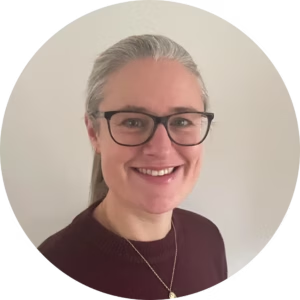
At the 2026 meeting in Atlanta, GA, USA, Hannah Fisher, Head of Medical at touchIME, was named as one of this year’s recipients. Ahead of the meeting, we spoke with Hannah about her career journey, the work she is most proud of and what it means to make a meaningful impact in medical education.
Can you tell us about your career journey into independent medical education?
I started my career as a medical writer in medical communications, and took what I think is a fairly classic route into the field. I studied molecular and cellular biology at university, and while I enjoyed the science, I realized quite early on that I wasn’t enjoying the practical laboratory work as much as I enjoyed the lectures themselves and applying what I was learning through a range of writing tasks.
When I started exploring career options that aligned with both my degree and my interests, medical writing consistently came up. It seemed like a perfect fit and, importantly for me, a way to continue to learn about science and healthcare. I began working as a medical writer in traditional medical communications and spent around a decade in that space, across several roles and organizations, working on a wide range of projects and therapy areas, with a particular focus on digital activities.
Over time, I had the opportunity to work with many excellent faculty and subject-matter experts, and I found myself increasingly drawn to the elements of the work that allowed me to build relationships with experts and really lean into their knowledge and experience. I started to think about how I could focus more on that and perhaps move away from some of the parts of traditional medical communications that I enjoyed less.
Around that time, a former colleague had joined touchIME, and after speaking with her about the work the organization was doing, it appeared to align perfectly with what I was looking for. I applied for a Medical Director role in 2019, was fortunate to be successful, and I haven’t looked back since.
Congratulations on receiving a Forty Under 40 award, which recognizes emerging leaders in independent medical education. What achievements are you most proud of in your career so far?
I’m very fortunate to work with a fantastic group of colleagues at touchIME, particularly within the medical team, who are all incredibly passionate about what we do and about improving patient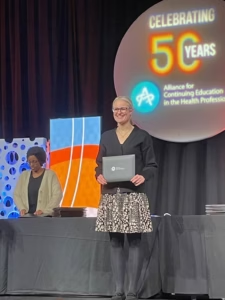 outcomes. Many of the achievements I’m most proud of are very much team efforts.
One area we’ve focused on significantly is increasing patient representation and the patient voice within our educational activities. This is becoming increasingly important across independent medical education, and we’ve been actively looking at how best to incorporate patients into our programs. Where appropriate, that means including a patient, patient advocate or caregiver as a genuine member of faculty.
For us, that’s a really important distinction. Patients aren’t added as an afterthought or asked to provide a brief perspective, they are involved from the outset in content planning and treated as true experts in their own right. Their insights play a meaningful role in shaping the activity and ensuring it meets its learning objectives for healthcare professionals. We’ve seen a real increase in the number of activities where we’ve been able to do this successfully.
Another project that stands out, albeit from a few years ago now, was our work during the COVID-19 pandemic, particularly around vaccine hesitancy. We delivered a series of educational modules across Africa and the Middle East, regions where hesitancy levels were high, working closely with local faculty and experts who understood the healthcare systems and cultural context. Delivering timely education that was genuinely tailored to those regions was a significant achievement.
What value do you see in attending the Alliance Annual Conference, particularly for those earlier in their careers?
I’m relatively new to attending the Alliance meeting, with 2025 being my first year. For me it was an incredibly valuable experience. At that point, I’d been working in independent medical education for around 6 years, but I’d had relatively few opportunities to meet other professionals working in the field outside of my immediate network.
The Alliance was the first time I’d really had the chance to connect with peers from a wide range of organizations, and the meeting format makes that very easy. There are lots of built-in networking opportunities, poster sessions, and shared breaks that encourage conversation and make it easy to meet people you might not otherwise encounter in your day-to-day work. For someone who is still relatively early in their IME career, that ability to quickly expand your network and hear different perspectives is hugely valuable.
The quality of the educational sessions themselves is excellent, and I was pleasantly surprised to find that the vast majority of them are interactive. I’m looking forward to attending again this year!
What are you most looking forward to at this year’s meeting?
Having looked through the programme, there’s a huge amount on offer again this year. I’m particularly interested in sessions that focus on activity design, implementation science and quality improvement, especially where continuing medical education can play a role in driving meaningful change.
Sessions on outcomes are always of interest as well, so I’ll certainly be trying to attend a few of those. There is a lot of great stuff again this year – it’s been hard to create my schedule and I wish I could clone myself and get to more of them!
Finally, what advice would you give to someone early in their career in medical education or healthcare communications?
One thing that has always stood me in good stead is not being afraid to ask questions. We work in a highly scientific field and alongside many experts, which can feel intimidating at times, particularly early on in your career.
I think it’s important to listen carefully, recognize when you have something to learn, and then have the confidence to ask questions. In my experience, experts are always happy to take the time to explain or provide more detail, and it’s one of the best ways to learn.
I try not to leave a meeting or a call thinking, “I wish I’d asked that” or “I still don’t quite understand this.” Adopting the mindset that there’s no such thing as a silly question has really helped me, and it’s something I’d strongly encourage others to embrace as well.

 Interested in discovering more about what we do? Reach out to learn about our educational activities, regular content and partnerships with medical societies.