Historically, patients played a passive role in healthcare, with little involvement in decision-making or medical education. However, in recent years, there has been a paradigm shift towards patient engagement, driven by advocacy efforts that have highlighted the value of patient perspectives in shaping medical education and research.
Patient advocacy groups have been instrumental in transforming clinical research from an exclusively investigator-driven model to begin incorporating a patient-centered approach. Regulatory bodies such as the US Food and Drug Administration (FDA) and European Medical Association (EMA) now strongly encourage patient-reported outcomes and active patient participation in study design.1 This growing recognition of patient voices has also extended to medical publications, with leading journals like The BMJ and JAMA incorporating patient commentaries and appointing patient representatives to editorial boards.2
Beyond research and publishing, patient involvement has become a fundamental aspect of medical education, and the concept of the “expert patient” – individuals with chronic conditions who contribute to the education of healthcare professionals (HCPs) – has begun to gain prominence.3,4 Research into the inclusion of patient perspectives in medical education suggest it promotes empathy, enhances communication skills and provide HCPs with a deeper understanding of diseases beyond clinical symptoms.5,6
“It’s amazing how fast medical education is evolving. Patients used to be almost invisible, but now their real-life voices and journeys are rightly central to our learning. This brings a depth and human touch to IME/CME that truly roots our education in the real world, making it more rounded and holistic – improving the lives of HCPs and their patients.” Tammy Gibbs, Managing Director, touchIME
But what impact is patient inclusivity and perspectives having on HCP learners? Are they actively seeking more of this kind of insight, and how is it shaping their approach to clinical practice? We fielded a survey to HCPs in our global network to ask about the impact of patient perspectives in CME activities on them and their clinical practice.
We gathered insights from 49 faculty across the 10 Touch Medical Media therapy areas (cardiology, dermatology, endocrinology, haematology, immunology, infectious diseases, neurology, oncology, ophthalmology and respiratory) with a global geographical spread including USA, Europe, Asia and South America. The survey fielded questions to understand the impact of patient perspectives on participation, depth of learning, the impact on clinical practice and their role in CME, along with how frequently they come across patient perspectives in the CME they participate in.
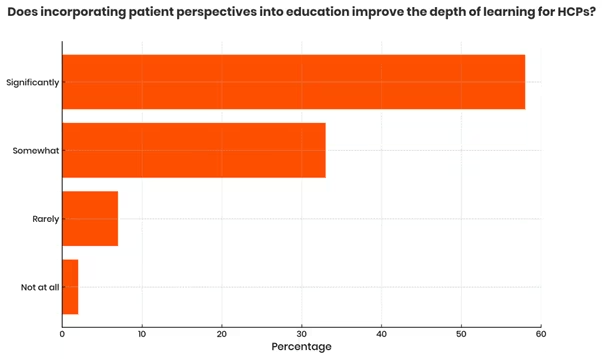
When asked about the impact of patient perspectives on the depth of learning in CME activities, a large majority of respondents (91%) noted that patient input enhances the depth of learning, with 59% identifying this impact as significant. None of the participants in our survey believed that patient perspectives detract from learning. This suggests that incorporating patient perspectives into CME activities is widely seen as beneficial, providing a positive impact on the learning experience without any perceived drawbacks.
Our own educational outcomes support the value of involving patient faculty. For example, in a recent activity involving patient faculty, learners showed good improvement in knowledge and competency, and over 50% reported that the education would directly impact their clinical practice. Qualitative post-education feedback also revealed that many learners intended to spend more time engaging with their patients and actively measuring quality of life.
Respondents in the survey recognized several benefits of patient-led or patient-involved education in clinical practice, including enhanced empathy and a deeper understanding of patient experiences (72%), improved shared decision-making (72%) and a broader perspective that goes beyond clinical knowledge alone (67%). These findings highlight the value of incorporating patient perspectives into education, by providing HCPs with a more holistic view that supports empathy and collaborative decision-making. In our experience, both HCP and patient faculty find significant value in including patient perspectives within educational activities. HCP faculty often report that hearing directly from patients helps to enhance communication beyond the educational setting, particularly in supporting shared decision-making in clinical practice. Patient faculty offer a different perspective, grounded in lived experience, which can provide practice-relevant insights and ultimately benefit the outcomes of other patients.
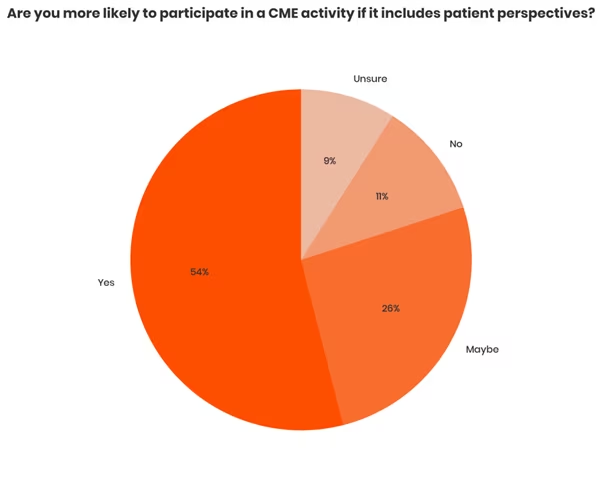
Moreover, according to our survey, patient perspectives can actively encourage HCP participation in CME activities, with 54% indicating a greater likelihood of engaging in educational sessions that feature patient contributions. This indicates that patient involvement in education improves clinical insight and can help to encourage greater HCP engagement in CME.
The survey did identify a gap in CME practices, with 54% of respondents saying they rarely or never encounter patient involvement, indicating that patient perspectives are not yet widely integrated into educational activities. At touchIME, we’ve made patient inclusivity a priority in recent years. In 2024, for example, 57% of our touchMDT activities, which highlight the value of a multidisciplinary approach to treatment and care, included a patient or patient advocate.
In response to our question, ‘Do you believe patient-inclusivity should be a core component of CME?’, there was clear support for greater integration of patient perspectives. A majority of respondents (74%) either strongly agreed or agreed that patient-inclusivity should become a core element of CME programs in the future, highlighting the value HCPs place on including the patient voice in medical education.
“We have found the involvement of patient faculty in our activities to be extremely beneficial. Patients often bring a very different perspective to that of healthcare professionals, so their inclusion allows our learners to see clinical topics through the lens of a patient and raises important discussion points that might otherwise be missed. This ultimately helps bridge the gap between clinical knowledge and its implementation in the real world, supporting optimal clinical practice.”
Hannah Fisher, Head of Medical, touchIME
Patient inclusivity is no longer seen as a novel idea and is increasingly becoming an important component of medical education and research. As healthcare and education continue to evolve, the role of the patient is expected to grow, fostering stronger collaboration between patients, educators and clinicians.
Educational formats specifically designed to support patient voices and personal stories, combined with advancing technologies that offer interactive learning environments have the potential to integrate the patient perspective more effectively.
At touchIME, we see the value of including patient perspectives in our education and are dedicated to evolving our approaches to incorporate the patient voice wherever possible. Findings from our survey highlight the value of including patient perspectives in the learning experience for healthcare professionals, although educational resources are still developing to fully meet this need. Through formats such as touchMDT (multidisciplinary team) and touchCASES, we continue to integrate the patient voice into our educational content.
We continue to monitor the impact of our educational activities, exploring how patient perspectives influence learner engagement, clinical decision-making, and ultimately, patient outcomes. Early insights suggest that patient-inclusive education fosters deeper reflection, greater empathy and more practical application of knowledge in real-world clinical settings.
By placing greater emphasis on the patient voice, the wider medical education community has the opportunity to not only build strong clinical expertise among future healthcare professionals but also support more human-centred, compassionate care that reflects the lived experience of those they serve.
References
- Bellino S, La Salvia A. The Importance of Patient Reported Outcomes in Oncology Clinical Trials and Clinical Practice to Inform Regulatory and Healthcare Decision-Making. Drugs R D. 2024;24:123–7.
- Richards DP. The patient as a person. 2018. Available at: http://blogs.bmj.com/bmj/2018/02/14/dawn-p-richards-the-patient-as-a-person/ (accessed 11 February 2025).
- Jha V, Quinton ND, Bekker HL, Roberts TE. Strategies and interventions for the involvement of real patients in medical education: A systematic review. Med Educ. 2009;43:10–20.
- Towle A, Farrel Cl, Gaines ME, et al. The patient’s voice in health and social care professional education: The Vancouver Statement. Int J Health Gov. 2016;21:18–25.
- Yang F, Lei F, Li Y, Yang T. Qualitative insights into empathy in medical education: perspectives from students, doctors, and educators. BMC Med Educ. 2025;25:473.
- Boshra M, Lee A, Kim I, et al. When patients teach students empathy: A systematic review of interventions for promoting medical student empathy. Can Med Educ J. 2022;13:46–56.