S2E10_ The power of the patient voice in medical education
The patient voice has become a pillar of medical education. In this episode, Nicky speaks with Tammy Gibbs, Managing Director at touchIME, about the growing importance of including patient stories and perspectives in educational content. From enhancing empathy to improving patient outcomes, Tammy shares how touchIME is putting patients at the heart of education and why true collaboration between HCPs and patients matters.
Transcript
[Nicky]: Hello, Nicky here, and welcome to today’s episode of Visionary Voices. I’m joined by Tammy Gibbs, Managing Director at Touch IME, to discuss the power of the patient voice and how incorporating the patient narrative into educational activities can enhance empathy, improve communication, and ultimately shape clinical decision-making and patient outcomes.
Hi Tammy, and welcome to Visionary Voices. [Tammy]: Hi Nicky. Thanks, it’s good to be here. [Nicky]: Oh, it’s my pleasure. I must admit it’s my first day back after the holidays, so you’ll have to bear with me while I get back into the swing of things today. [Tammy]: Oh, no worries. We all know what it’s like catching up on emails. [Nicky]: Thanks! So today we’re talking about bringing the patient voice into independent medical education, or IME as it’s often shortened to. I know this is something you and the Touch IME team are really passionate about. But before we get into it, I’d love to hear what made you choose a career in IME. [Tammy]: Really good question. I’ve always been involved in healthcare in different ways. I can’t say I set out to choose it as a career, but from the moment I was first exposed to IME, I just felt at home. There’s something about being able to support people and make a positive impact on their lives. It just made sense to me. It has a real feel-good factor, if you like. [Nicky]: Amazing. Earlier this season on Visionary Voices, I spoke with your Touch IME colleagues, Hannah and Matt, about the evolving world of IME. But for anyone who missed that episode, could you briefly explain what IME is and how it differs from other types of medical education? [Tammy]: Sure, I’ll try to keep it brief. Independent medical education, or IME, is education for doctors and healthcare professionals that is not influenced by pharmaceutical companies or commercial interests. Our role as an IME provider is to deliver unbiased, evidence-based information that helps improve patient care. It’s very different from sponsored education, where a pharma company might influence the content or messaging in a promotional way. IME is the exact opposite of that. [Nicky]: That makes sense. So where do patients or patient advocates come into the picture? [Tammy]: It’s something I’m really passionate about, and I’d say the whole company feels the same. More and more, we’re realising how important it is to hear directly from patients. Including their voices in medical education helps doctors understand not only the science but the real-world impact of disease. It can also influence their treatment decisions in a more meaningful way. Advocates and patients can share their lived experiences, including what worked for them, what didn’t, how care felt, and what the patient journey was like. That insight is incredibly valuable, and it’s also a powerful educational tool. [Nicky]: So why do you think bringing the patient voice into educational activities is so important? [Tammy]: It’s a big question, but actually quite simple to answer. Medicine isn’t just about treating diseases. It’s about treating people. Including patients in the learning process reminds healthcare professionals to connect, empathise, and care with heart. It’s not just about gaining knowledge. We believe it leads to better outcomes for everyone, and we’ve experienced that first-hand at Touch. I’d also say that stories are powerful because they connect with us emotionally. Our brains are wired for narrative. We don’t just process facts — we feel stories. When we hear a patient describe what it’s like to wait for a diagnosis or deal with side effects, it activates empathy, attention and memory in a way that data and bullet points can’t. [Nicky]: I love that storytelling aspect. Could you give an example of how a patient story might make a difference in a medical education activity? [Tammy]: Definitely. It’s something we’re doing more and more. Imagine a session on diabetes. The slides might show blood sugar targets and medications, but when a patient shares how hard it is to stick to a meal plan while working two jobs, or how side effects made them stop taking treatment, it brings the session to life. That kind of story helps healthcare professionals think more holistically. We’ve seen that it encourages them to become better listeners or ask different questions. That’s where storytelling makes a real impact. [Nicky]: So it’s about putting real-life patient challenges alongside clinical ones. I remember from speaking with Hannah that Touch IME has a lot of experience working with patient faculty. What do you think educators or organisers should keep in mind when bringing patients into medical education? [Tammy]: Great question. A few things come to mind straight away. First, it’s essential to prepare and support the patients or advocates. They may never have done anything like this before, especially if they’re sharing personal or difficult stories. So guiding them through the process is really important. Listening is another key point — really listening to what they’re saying, even if it’s uncomfortable. When done properly, patients aren’t just guests. They’re co-educators. They are part of the faculty. And, of course, they should be compensated fairly. It’s their time, their expertise, and their experience. That adds enormous value to the education. [Nicky]: I completely agree. And we know from feedback that many HCPs see huge value in working alongside patients in medical education. But how do you think patients benefit from being part of the process? [Tammy]: I’m really glad you asked. It’s a fascinating aspect. I do believe that patients benefit — and we’ve seen it ourselves. Many of the patients and advocates we’ve worked with have said they feel heard and empowered. They love knowing they’re making a difference in how future patients are treated. At its best, it can even be healing. That might sound dramatic, but turning a tough health journey into something positive and shared can have a powerful effect. [Nicky]: That’s really encouraging to hear. What kind of response do you usually see from HCP learners when they hear directly from patients? [Tammy]: The response is always really positive. Doctors, nurses, primary care professionals — across the board, they tell us it’s the part of the education that stays with them the longest. Hearing a patient describe their real-life experiences, their fears, frustrations, and moments of hope puts things into perspective. We’ve had learners tell us it reminds them why they went into healthcare in the first place. And rather than diluting the science, it actually enhances the session. Some HCPs have said it changed how they speak with patients or helped them see beyond the lab results. It’s not always comfortable, especially when the patient shares something difficult or critical, but that discomfort can be transformative. [Nicky]: I’ve seen that too. And from a learning perspective, what impact does including the patient voice have on outcomes? [Tammy]: The impact is significant. When you include patient voices or cases well, the learning really sticks. That’s crucial when you’re thinking about turning knowledge into action. It moves a session from being purely informational to something more transformational. Feedback and research show that healthcare professionals are more likely to retain knowledge, change behaviour, and apply what they’ve learned when they connect emotionally and empathetically with a patient story. It also improves clinical empathy — the ability to understand what a patient is going through and tailor care accordingly. It’s not just about knowing guidelines and treatments. It’s about applying them in a way that actually works for the patient in front of them. [Nicky]: It really shows how important the patient voice is. But do you think there’s a risk of patients being used in a tokenistic way — just to tick a box? [Tammy]: That’s a really interesting point, Nicky. I certainly hope that’s not the case, but it’s a valid concern. Having a patient speak isn’t enough if their voice isn’t truly respected or valued. Their involvement has to be meaningful — from the very start of the process. That includes needs assessment, proposal development and throughout the activity. They shouldn’t be a last-minute add-on. And I think patients would recognise that kind of tokenism. It would feel disingenuous. At a basic level, this should be a real partnership, not a performance. [Nicky]: I’ve seen some of the Touch IME activities that involve patients, and like we said earlier, they really are treated as co-educators. We’re nearly out of time — it’s gone so quickly. But one final question: what are you doing at Touch IME to include patients in the most meaningful ways? [Tammy]: Thanks for asking — it’s so important. At Touch, we’ve made it a priority to bring patients into the heart of education. That means not just inviting them to speak, but collaborating with them from the very start. That includes designing the education, developing the scientific content, and even co-creating proposals with physician and patient faculty together. We decide collectively what matters most. And it works really well. We’ve worked with advocates from many different organisations, which has been fantastic. We recently launched a dedicated patient cases activity, which we’re all excited about. And we’ve got more in the pipeline — maybe a future podcast topic for you, Nicky! We’re also reviewing and improving how we train and support patients. That’s key. We want them to feel confident and safe sharing their stories, especially when the education is going to a global audience. It can feel quite daunting. Ultimately, our goal is to create education that’s not just clinically accurate, but also human-centred. When patients are part of the learning, everyone benefits — especially future patients. That’s the foundation of everything we do. [Nicky]: It’s such an important collaboration. Thank you, Tammy, for sharing all these amazing insights. I look forward to seeing more Touch Cases as they launch and seeing how the patient voice continues to evolve in medical education. [Tammy]: No problem, Nicky. Thanks for having me. Great questions — maybe even a few tricky ones in there too! [Nicky]: Thanks, Tammy. And thank you to our listeners for joining us today. Don’t forget to subscribe to Visionary Voices on Apple Podcasts, Spotify, Amazon Music, or Podbean if you haven’t already. Until next time, goodbye.
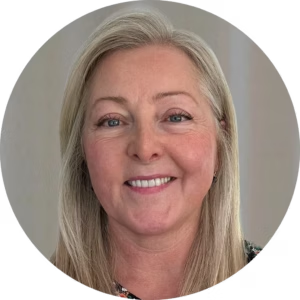 As the Strategic Education Director at Touch Independent Medical Education, Tammy leads a fantastic team in delivering cutting-edge, evidence-based medical education to healthcare professionals globally. Over her seven years at touchIME, Tammy has had the privilege of building strong relationships with supporters, professional societies and key opinion leaders. Here focus is on ensuring touchIME’s educational programs provide the highest quality and value to learners.
Learn more about touchIME here.
Enjoyed todays episode? Subscribe to Visionary Voices to receive new episode alerts now
This content has been developed independently by Touch Medical Media. Unapproved products or unapproved uses of approved products may be discussed; these situations may reflect the approval status in one or more jurisdictions. No endorsement of unapproved products or unapproved uses is either made or implied by mention of these products or uses by Touch Medical Media. Views expressed are the speaker’s own and do not necessarily reflect the views of Touch Medical Media.